



CIS First time buyer Joint mortgages

Joint Mortgages when one of you gets paid through CIS

Our niche is helping tradies (and their partners) find mortgages with lenders that accept pay through the Construction Industry Scheme

There’s only a small group of lenders that do, and you should know because if you apply to the wrong lender, you could get rejected or be capped at borrowing a smaller figure based on your post-tax income. 

How to get a mortgage when one of you is a contractor and one of you is employed

You could borrow more with a lender that accepts CIS statements, as opposed to your tax returns.

A benefit of doing that is that both you and your employed partner, who is paid through PAYE (paid as you earn), can borrow based on pre-tax income (not what’s been earned after tax).

Example of how much two people can borrow on a joint mortgage

Hypothetically, let’s say you’re an electrician earning £200 a day. You work five days a week, resulting in a grand a week. 

Some lenders will multiply your gross income by 46 (for 52 weeks in a year minus 6 weeks for presumed time taken off). 

That would mean your income on the application would be £46,000. 

Then there’s your partner’s income. Hypothetically, let’s say they earn £36,000 as a primary school teacher and are paid through the standard PAYE (pay as you earn) system.

Usually, though not always, CIS mortgage lenders will assess both incomes before tax, combine them, and then multiply by 4.5 to 6 times. That’s how they calculate how much you can borrow for your joint mortgage. 
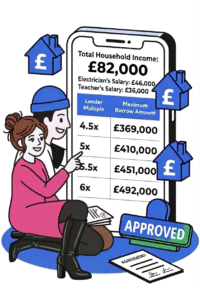
an electrician paid through the contruction industry scheme and a teacher paid through PAYE look at how much they can borrow on a mortgage - opportunity mortgages helps tradesmen and women and their partners find joint mortgages

Let’s talk about your options

  • Contact Opportunity Mortgages
  • We’ll listen to what you need from a joint mortgage.
  • You send us a copy of each applicant’s passport, proof of address, bank statements and proof of income (PAYE slips and CIS payment and deduction statements). 
  • We’ll ask about bad credit and listen without judgment if you or your partner has recent debt or other credit issues. 
  • Based on the information you provide us with, we’ll find you a possible match for a mortgage lender without affecting your credit score.
  • We’ll compare a range of options that could be suitable, including lenders that could treat gross turnover as income, not the amount left after tax. 
  • The higher income figure may allow you and your partner to borrow more (so you can look at better or bigger homes).
  • If you’re happy to apply, we’ll fill out the application to help you avoid mistakes that might otherwise slow the process down.
  • We’ll keep you both updated about the progress of your mortgage application.

We find mortgages for tradespeople